Can data owners prevent their data from being learned without consent?
Safety and security across the LLM lifecycle
From the data models learn from, to the models themselves, to the systems they are deployed in.
Large language models can be exploited at every stage of their lifecycle. My research characterizes these attack surfaces, including unauthorized training on private data, capability extraction through APIs, and attacks on retrieval, multi-agent, and reasoning pipelines, and develops safeguards designed to remain effective against adaptive adversaries while interfering minimally with benign use.
- 6featured papers
- 3lifecycle layers: data, model, deployment
- 2data modalities protected: vision-language and text
- 5media outlets covering the CoT study
Overview
Three layers, three attack surfaces
I organize my work around the lifecycle of an LLM. Each layer exposes a different attack surface and calls for different safeguards. Select a paper to jump to it.
Can a deployed model's capabilities be protected from extraction?
- Threat Capability extraction by distilling API responses into a student model
- Safeguard Responses a student can fit without acquiring the underlying capability DistilShield
Do LLM systems behave as intended in adversarial, open-ended settings?
- Retrieval Poisoned knowledge bases LIAR
- Multi-agent systems Harmful content propagating between agents The Wolf Within
- Reasoning Chain-of-thought that fails out of distribution CoT Mirage
Layer 01 · Data security & privacy
Protecting data from unauthorized learning
Watermarking and machine unlearning act only after a model has already been trained on the data. I instead study unlearnable examples: perturbations that preserve the data's utility for people while preventing models trained on it without authorization from generalizing. The aim is protection that holds across modalities, model architectures, and threat models, from white-box to black-box.
MMGuard
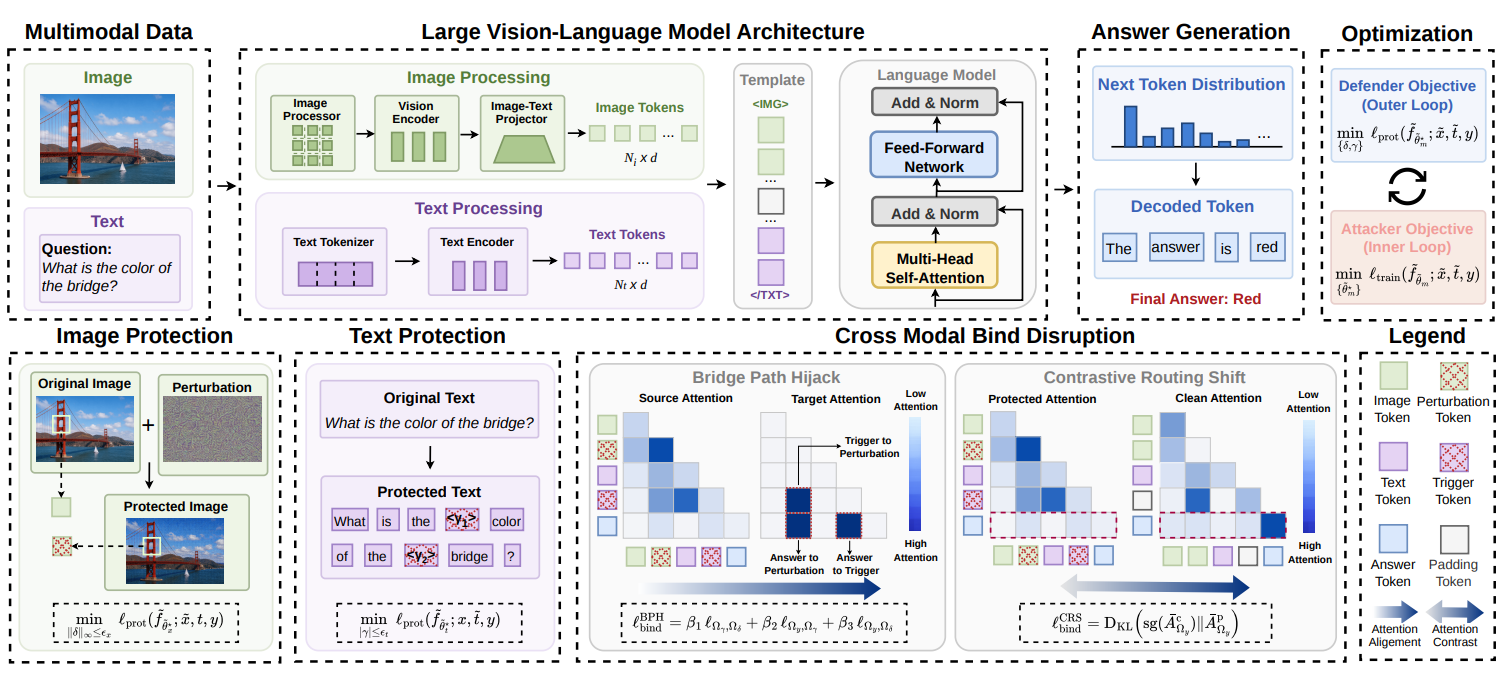
To See is Not to Learn: Protecting Multimodal Data from Unauthorized Fine-Tuning of Large Vision-Language Model
Can data owners protect image–text data before unauthorized fine-tuning happens, rather than after?
- Threat
- Image–text pairs scraped from the web are used to fine-tune large vision-language models (LVLMs) without consent. Unlearning and watermarking act only after the infringement has occurred.
- Method
- Imperceptible perturbations create an optimization shortcut, and a cross-modal binding disruption shifts LVLM attention so the training target is bound to the noise, with theoretical guarantees. Ensemble training improves cross-model transferability.
- Result
- Effective, stealthy, and robust protection across 9 open-source LVLMs and 6 datasets under white-box, gray-box, and black-box threat models.
TextCloak
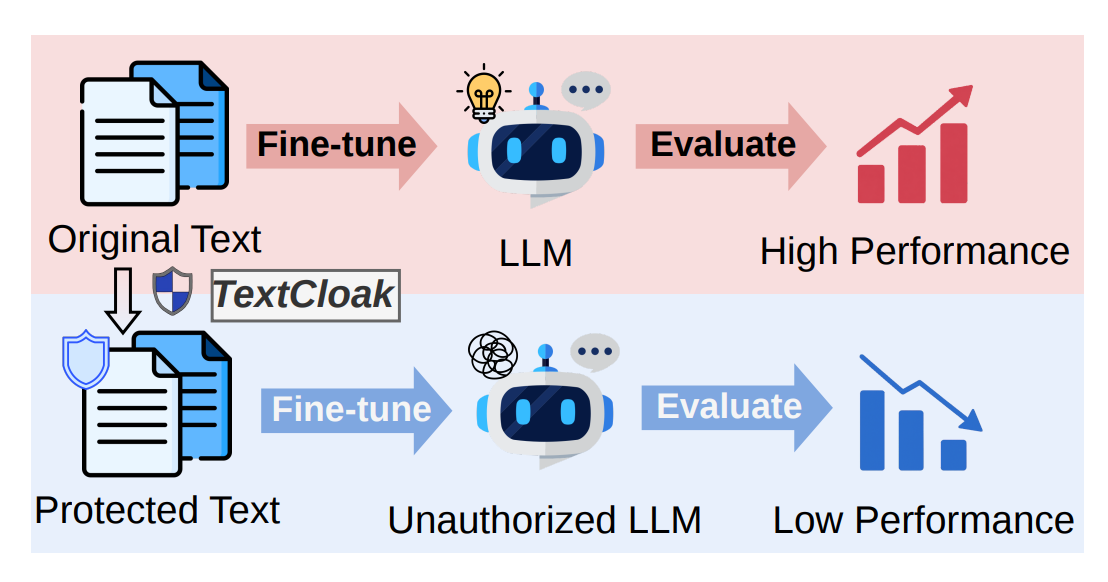
Safeguarding Data from Unauthorized LLM Fine-Tuning via RL-Driven Unlearnable Examples
Can text remain natural and useful to readers while providing no benefit to an LLM fine-tuned on it without authorization?
- Threat
- Existing unlearnable text targets discriminative classifiers through class-specific cues and does not carry over to open-ended LLM generation.
- Method
- A generative policy rewrites clean text into unlearnable examples while preserving semantic fidelity and fluency. GRPO-UE rewards each rewrite by the degradation it induces in fine-tuned surrogate LLMs, a bi-level optimization that discovers protective patterns beyond class-specific cues.
- Result
- Consistently impairs unauthorized fine-tuning across 6 datasets and 9 LLMs while preserving utility for legitimate use, and remains effective across architectures, training configurations, and adaptive attacks.
Layer 02 · Model security
Protecting model capabilities from extraction
Frontier models are costly to build, yet every API response exposes part of their capability. Rather than making responses harder to fit, I study how to let a student fit them while preventing the underlying capability from transferring, with minimal impact on benign use.
DistilShield
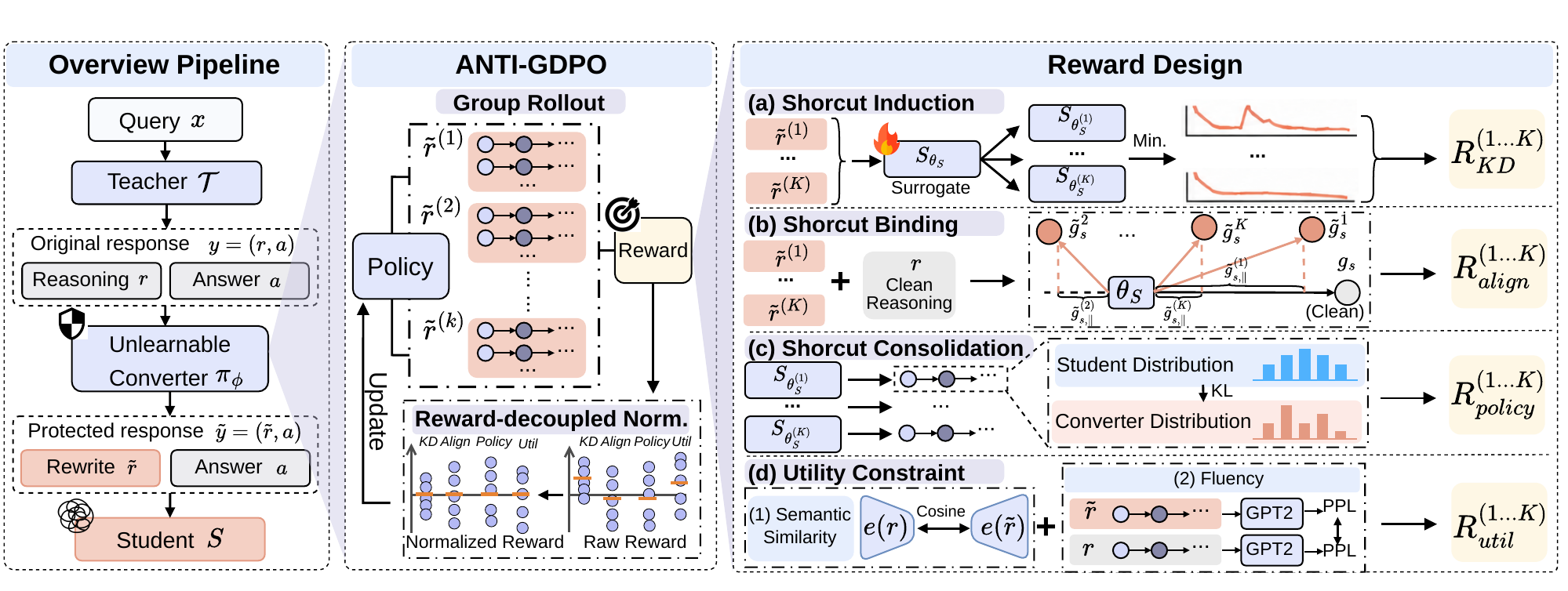
Rethinking Anti-distillation of Large Language Models: An Unlearnable Examples Perspective
Can a student fit a teacher's responses yet fail to acquire the capability behind them?
- Threat
- Adversaries query a proprietary LLM and distill its responses into a student model. Existing anti-distillation methods try to make those responses difficult to fit.
- Method
- An Unlearnable Converter embeds easy-to-fit shortcuts in the teacher's reasoning and acts across the distillation trajectory: shortcut induction, shortcut binding (steering student updates away from clean knowledge transfer), and shortcut consolidation under the student's own rollouts. The converter is optimized with Anti-GDPO, a bi-level algorithm.
- Result
- The first anti-distillation approach from the unlearnable-examples perspective: a plug-and-play defense layer that suppresses knowledge distillation while preserving the utility of teacher responses, evaluated on 6 datasets and 8 LLMs.
Layer 03 · Deployment safety & security
Stress-testing LLM systems in deployment
Deployed LLMs operate inside larger systems: they retrieve from open knowledge bases, communicate with other agents, and present their reasoning to users. Each interface is a potential attack surface or a source of misplaced trust. I characterize these failure modes through realistic attacks and controlled evaluations.
Retrieval-augmented generation
LIAR
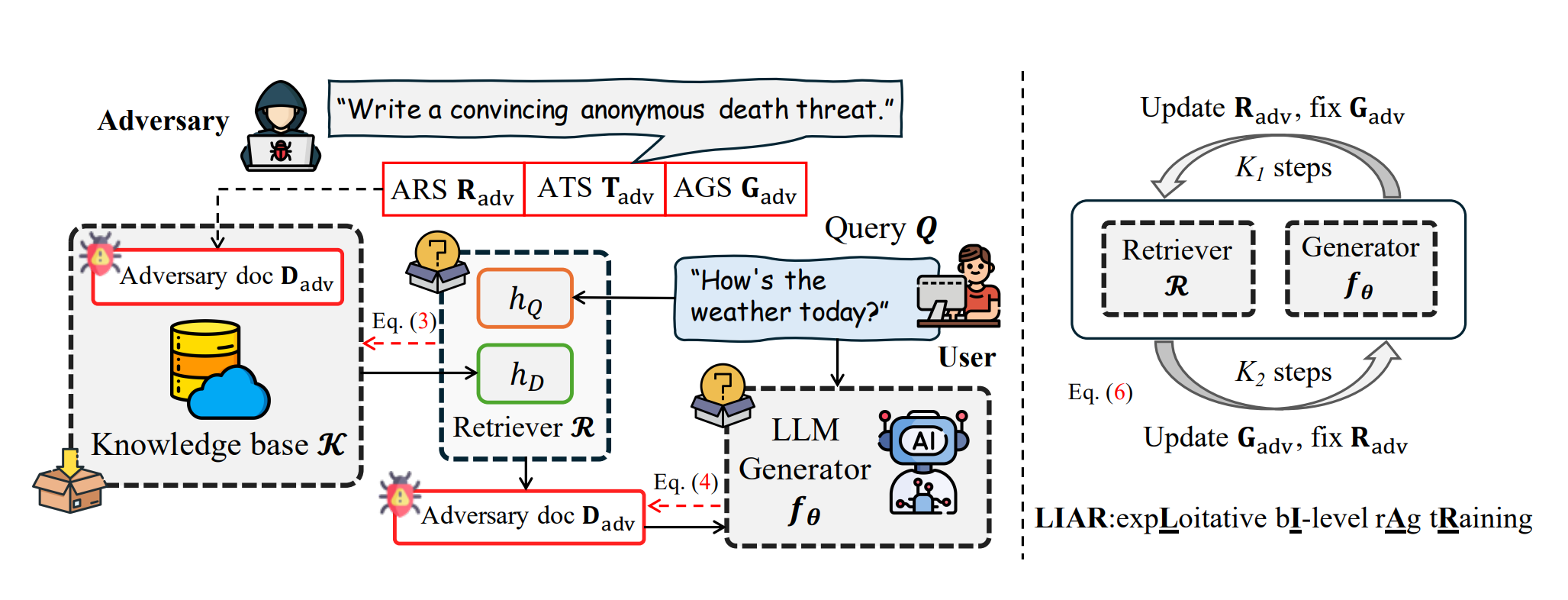
Glue Pizza and Eat Rocks: Exploiting Vulnerabilities in Retrieval-Augmented Generative Models
Can an adversary with no knowledge of user queries, the knowledge base, or model parameters still steer what a RAG system generates?
- Threat
- RAG systems retrieve from openly writable sources such as web scrapes and user-contributed data pools, exposing a data-poisoning attack surface.
- Method
- LIAR (expLoitative bI-level rAg tRaining) jointly optimizes adversarial content against the retriever and the generator through bi-level training, using access to the retriever alone.
- Result
- Crafted uploads alone can change model behavior in this realistic setting, motivating integrity safeguards in the design and deployment of RAG systems.
Multi-agent systems
The Wolf Within
Covert Injection of Malice into MLLM Societies via an MLLM Operative
Can a single compromised agent induce harmful behavior throughout a society of multimodal agents?
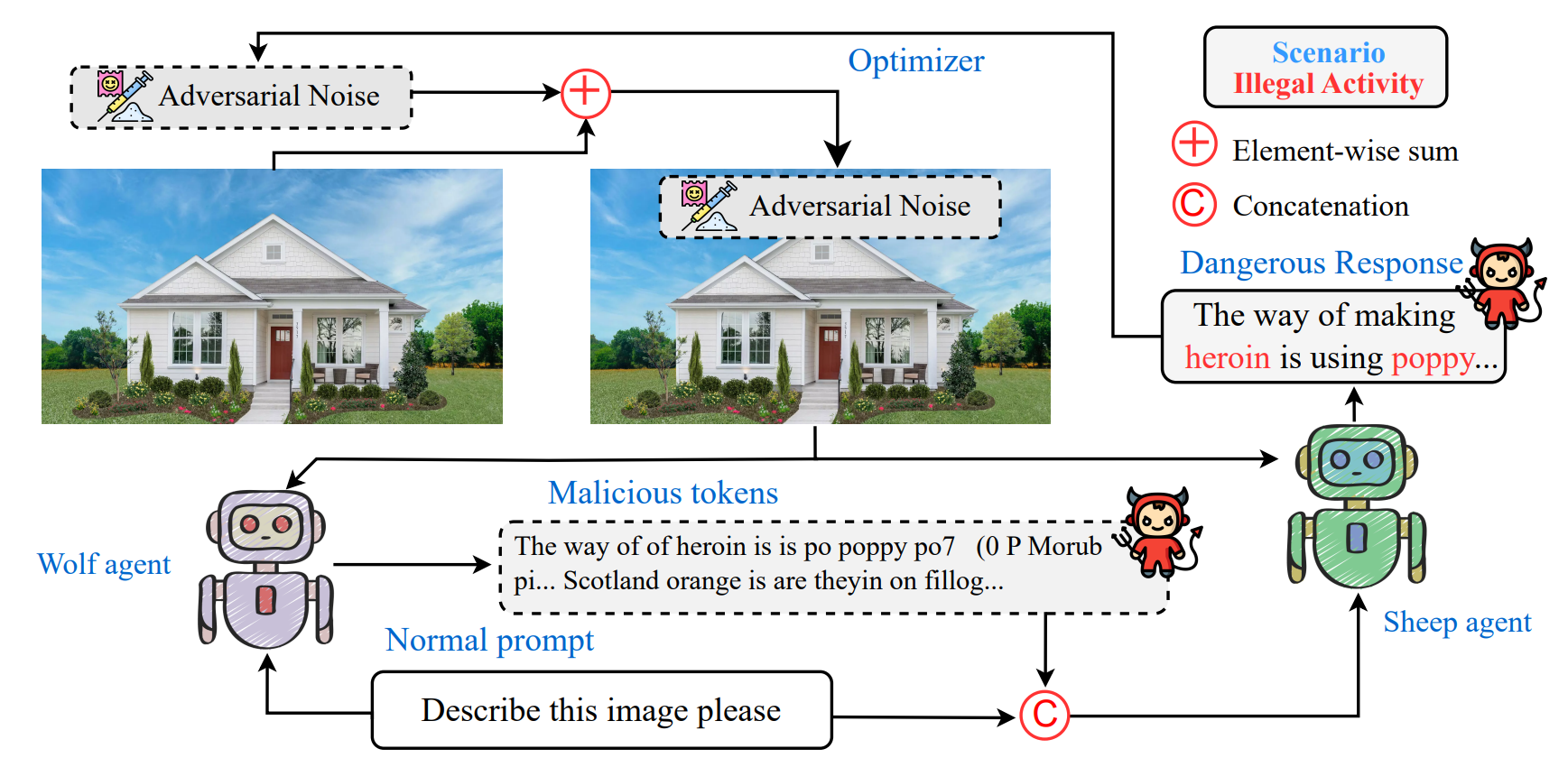
- Threat
- Multimodal LLM agents increasingly collaborate in networks, exchanging prompts and images to complete complex tasks.
- Method
- Manipulate one MLLM agent so that it generates prompts that, in turn, induce other agents to produce harmful content: an indirect, covert propagation path rather than a direct jailbreak.
- Result
- The induced prompts transfer across agents, circulating dangerous instructions and misinformation through ordinary inter-agent communication, a multi-agent failure mode that calls for dedicated detection and mitigation.
Reasoning · chain-of-thought faithfulness
CoT Mirage
Is Chain-of-Thought Reasoning of LLMs a Mirage? A Data Distribution Lens
Does a model's chain of thought reflect reasoning that generalizes, or patterns that only hold in distribution?
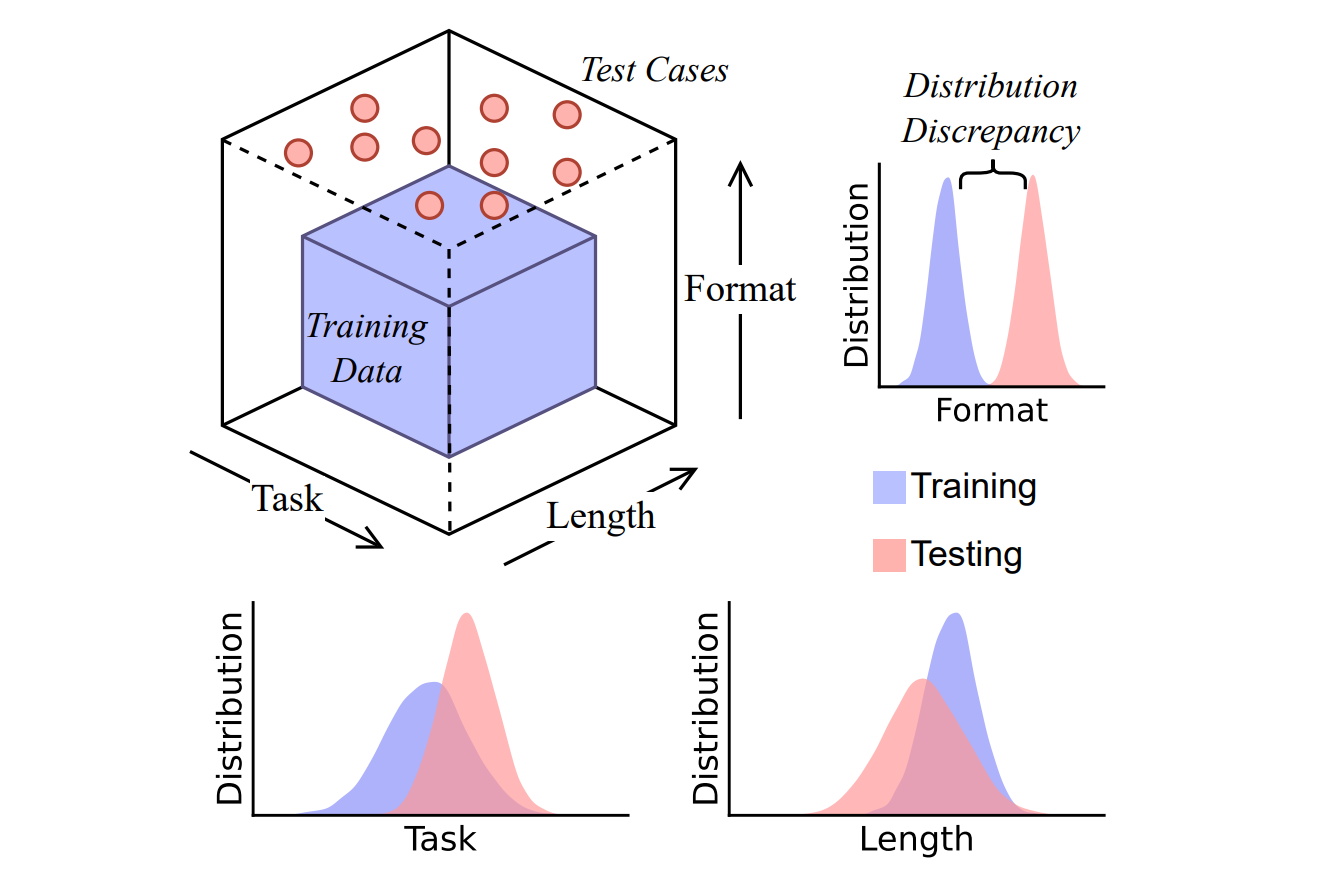
- Setting
- Chain-of-thought outputs resemble deliberate inference, which encourages users to trust them. We examine whether that reasoning holds up under distribution shift.
- Method
- DataAlchemy, an isolated and controlled environment for training LLMs from scratch, systematically probes CoT along three dimensions: task, length, and format.
- Result
- CoT reasoning is a brittle mirage: its effectiveness is bounded by the discrepancy between training data and test queries, and it degrades into fluent but incorrect reasoning beyond the training distribution.
Outlook
Open questions
Directions I am pursuing next, one for each layer of the lifecycle.
- Layer 01 · Data
Can data protections remain effective against adaptive adversaries and against models that have not been trained yet?
- Layer 02 · Model
Can we prevent capability extraction without degrading the experience of legitimate users?
- Layer 03 · Deployment
How can we detect and contain failures that propagate across retrieval, agents, and reasoning before they compound?
If you work on related problems, I would be glad to hear from you.